Source Anti Static Cut Flower Chiffon for Garments, Hats, and Bags
Compare 30 listings for anti static cut flower chiffon suitable for garment decoration, hat accessories, and bag embellishments. Buyers can evaluate specifications like 75D and 100D standards, customization options, and packing methods from suppliers in Wujiang and Guangdong.
Key considerations
Products List




Comprehensive Sourcing Guide
Strategic Sourcing Guide for Anti-Static Cut Flower Chiffon
Understanding Product Definitions and Technical Specifications
When sourcing "anti-static cut flower chiffon," buyers must first distinguish between the raw fabric material and the finished decorative application. The supplied data indicates a complex supply chain where "Synthetic Fiber Fabric" serves as the base for "Garment Handmade Flowers" and "Artificial Flowers." The core material identified is "Chiffon," a lightweight, sheer fabric often derived from "Polyester," "Silk," or "Velvet." In the context of this specific keyword, the product is likely a polyester-based chiffon cut into floral shapes, treated or inherently possessing "Anti-Static" properties to prevent dust attraction and static cling during garment assembly.
Technical specifications vary significantly across the available product pool. The "prod_standard" field reveals a wide range of numerical designations, including "75D," "68DX120D," and "100D." These figures typically refer to the denier, a unit of measure for the linear mass density of fibers. A "75D" or "100D" chiffon suggests a specific thickness and drape quality, which is critical for the structural integrity of cut flowers. Furthermore, the "prod_model" identifiers such as "J-66," "ACHF-001," and "Z659-1" suggest that manufacturers utilize specific internal coding for these variations. Buyers must verify that the specific denier and model number align with the desired aesthetic and functional requirements of the final garment.
The physical dimensions of the cut flowers are equally variable. While some listings specify "Various Sizes, as Your Request," others provide concrete measurements like "1cm/1.5cm/2cm/2.5cm" or a standard "10cm" size. The "Size" specification is a primary driver of customization. Additionally, the "Theme" is explicitly noted as "Flower," and the "Product Name" often includes "Garment Handmade Flowers" or "DIY Fabric Flower," indicating that the product is intended for decorative application rather than structural fabric use. The "Thread" used in these constructions is frequently "Indian Metallic Thread" or "Polyester Yarn," which adds a specific visual texture and potential static generation factor that the anti-static treatment must mitigate.
Compliance, Certification, and Material Verification
In the B2B textile sector, compliance is a critical differentiator, yet the supplied data presents a nuanced picture regarding certifications. The "Low-confidence background" section lists "GOTS" (Global Organic Textile Standard) and "OEKO-TEX" as potential standards, but these are explicitly flagged as background information not to be used for concrete claims. This distinction is vital for procurement professionals. While the product is described as "Synthetic Fiber Fabric" and "Polyester," which are generally not organic, buyers should not assume GOTS certification applies unless explicitly verified by the supplier.
Instead of relying on assumed certifications, buyers must focus on the verified attributes present in the data. The "Anti-Static" attribute is a high-confidence fact, meaning the product is marketed and likely engineered to reduce static electricity. This is particularly important for "Artificial Flowers" used in "Shirts, Coats, Pants/Trousers," where static can cause the flowers to cling to the fabric or attract lint. The "Main Material" list includes "Polyester, Velvet, Silk, Satin, Chiffon," suggesting that the anti-static treatment must be compatible with these diverse fiber types.
Regarding chemical safety and environmental standards, the absence of confirmed certification data in the high-confidence list means buyers must request specific test reports. The "prod_standard" field contains entries like "Customized" and "MULTI," which implies that compliance standards may be tailored to the buyer's specific market requirements rather than adhering to a single universal standard. For instance, if a buyer targets the European market, they may need to verify OEKO-TEX compliance independently, as the provided data does not confirm this status. The "prod_origin" locations, including "Wujiang," "Guangdong, China," and "Zhejiang, China," are major textile hubs, but origin alone does not guarantee compliance. Buyers should treat the "Anti-Static" claim as a functional requirement to be validated through third-party testing rather than a certified status.
Cost Drivers and Pricing Dynamics
The pricing structure for anti-static cut flower chiffon is influenced by several distinct factors derived from the observed data. The "Observed listed price range in USD" is noted as "0.01-3.1," indicating a broad spectrum from low-cost commodity items to higher-end, specialized products. This wide range suggests that price is heavily dependent on the complexity of the "Technics" and the "Material" composition. Products described as "Handmade" with "Indian Metallic Thread" likely command prices at the higher end of the spectrum compared to machine-cut, simple polyester variants.
The "MOQ" (Minimum Order Quantity) is another significant cost driver. The "Observed MOQ range" spans from "20" to "5000," with a specific high-confidence fact noting an "MOQ: 500PCS." This variability allows for flexibility in procurement strategies. Small buyers or those testing new designs can source with lower quantities, while large-scale manufacturers may leverage the higher MOQs to negotiate better unit economics. However, the "7 Days Sample Order Lead Time: Not Support" fact suggests that sample availability may be restricted or that sample costs are bundled into the first production order, which can impact the initial cost of entry for new buyers.
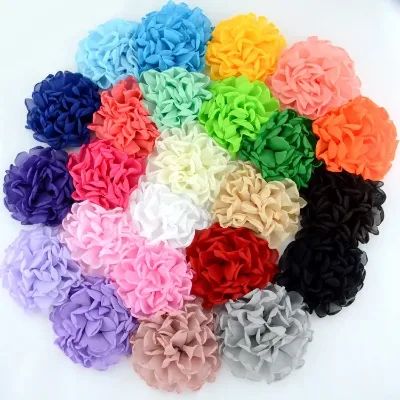
Packaging also plays a role in the final landed cost. The data lists multiple packaging standards, including "Roll Packing," "OPP Bag Inner Packing+Outer Packing Stander Export," "CTN/Bag," and "Carton." The complexity of the packaging, such as the "Outer Laye" (likely Outer Layer) mentioned for model "YW-2251," adds to the material and labor costs. Furthermore, the "Customization" attribute is listed as "Available," which invariably increases the unit price due to the setup costs for custom molds, cutting dies, or specific color formulations. Buyers must balance the desire for customization against the price increase, especially given the "Color" options ranging from "White" and "Multi" to specific shades like "Red, Pink, Green, Gray, Gold, Brown, Blue, Black."
Typical Applications and Usage Scenarios
The versatility of anti-static cut flower chiffon is evident in the extensive list of "Usage" scenarios provided. The primary application is in the "Garment" sector, specifically for "Shirts, Coats, Pants/Trousers," and "Bags." The "Anti-Static" feature is particularly valuable here, as static electricity can cause decorative elements to detach or create an uncomfortable sensation for the wearer. The "Gender" is listed as "Unisex," and the "Age Group" as "All," indicating that these flowers are suitable for a broad demographic, from children's accessories to adult formal wear.
Beyond general apparel, the product is specifically designed for "Hair Accessories" and "Hat" embellishments. The "Occasion" field highlights seasonal and celebratory uses, including "Christmas, Easter, Halloween, New Year." This suggests that the product is often used for festive costumes, holiday-themed garments, and event-specific accessories. The "Backing" options, which include "Iron on, Sew on, PVC, Self-Adhesive, Non-Woven," further expand the application scope. For instance, "Self-Adhesive" backing is ideal for quick application on "Hair Accessories," while "Sew on" or "Iron on" options are better suited for "Coats" and "Shirts" where durability is paramount.
The "Theme" of "Flower" and the "Keyword" of "Artificial Flowers" confirm that these are decorative elements intended to mimic natural blooms without the fragility of real plants. The "Technics" of "Handmade" suggest a high level of detail and craftsmanship, making them suitable for premium "DIY Fabric Flower" projects or high-end fashion design. The ability to customize the "Size" and "Color" allows designers to create unique collections that match specific brand identities or seasonal trends. Whether for a "Christmas" tree decoration or a "Halloween" costume, the anti-static property ensures the flowers remain in place and look pristine throughout the event.
Supplier Evaluation and Geographic Considerations
Evaluating suppliers for this specific product requires a careful analysis of the "prod_origin" data. The supplied facts identify three primary manufacturing hubs: "Wujiang," "Guangdong, China," and "Zhejiang, China." These regions are renowned for their textile expertise, with Wujiang being a major center for synthetic fibers and Guangdong known for its diverse manufacturing capabilities. The presence of multiple origins suggests a competitive market, but it also means buyers must verify the specific capabilities of each supplier.
When evaluating a supplier, buyers should look for the "Customization" capability. The data confirms that customization is "Available," but the extent of this service varies. Some models, like "ACHF-001," have a "Standard" of "Customized," while others have specific model numbers like "Z659-1" with "MULTI" standards. A supplier that offers "Customized" standards is likely more flexible regarding "Size," "Color," and "Backing" options. The "Brand Name" is listed as "OEM," indicating that most suppliers operate on a private label basis, which is standard for B2B procurement. Buyers should ensure the supplier can handle their specific branding requirements without compromising the "Anti-Static" quality.
The "prod_packing" methods also serve as an indicator of supplier professionalism. Suppliers offering "Export" standard packaging, such as "OPP Bag Inner Packing+Outer Packing Stander Export," demonstrate a commitment to protecting the product during transit. In contrast, simpler "CTN" or "Carton" packing might be suitable for bulk shipments but less ideal for delicate handmade flowers. Buyers should also check the "Lead Time" and "Sample Order" policies. The fact that "7 Days Sample Order Lead Time: Not Support" is a critical red flag for buyers needing rapid prototyping. A supplier that cannot provide quick samples may indicate a rigid production process or a lack of flexibility, which could hinder the buyer's ability to validate the "Anti-Static" performance before committing to a large order.
Quality Control and Long-Term Procurement Strategy
Quality control for anti-static cut flower chiffon must focus on the integrity of the "Anti-Static" treatment and the durability of the "Handmade" construction. Since the "Material" includes "Polyester" and "Silk," the treatment must not degrade the fabric's natural properties or cause discoloration. Buyers should verify that the "Thread," specifically "Indian Metallic Thread," does not compromise the anti-static function, as metallic threads can sometimes conduct electricity differently than the base fabric. The "Backing" options also require quality checks; "Self-Adhesive" backings must maintain their stickiness over time, while "Iron on" backings must withstand repeated washing without peeling.
Long-term procurement strategies should prioritize suppliers who offer consistent "Standard" compliance. The data shows a mix of specific standards like "75D" and "100D" alongside "Customized" standards. For a stable supply chain, buyers should aim to standardize their requirements on specific denier and model numbers to ensure consistency across batches. The "MOQ" range of "20-5000" allows for a phased approach, starting with smaller orders to test quality and scaling up to larger volumes once the supplier's reliability is established.
Buyers should also consider the "Color" consistency. With options ranging from "White" to "Multi" and specific shades like "Gold" and "Black," color matching is crucial. Suppliers must demonstrate the ability to reproduce colors accurately across different production runs. Finally, the "Location" of the supplier impacts logistics and lead times. Suppliers in "Wujiang," "Guangdong," and "Zhejiang" are all within China, but their proximity to ports and their specific logistics networks can affect the "Lead Time" for international shipments. Establishing a long-term relationship with a supplier who understands the nuances of "Handmade" production and "Anti-Static" requirements will be key to maintaining product quality and meeting market demands efficiently.
FAQs
What materials are used for anti static cut flower chiffon?
The main materials include polyester, velvet, silk, satin, and chiffon. These synthetic fiber fabrics are often treated to reduce static electricity while maintaining a lightweight and sheer appearance suitable for garment decoration.
Can I customize the size and color of the flowers?
Yes, customization is available for both size and color. Buyers can request various sizes ranging from 1cm to 10cm and choose from colors like white, red, pink, green, or multi-color options based on specific design needs.
Which backing options are available for application?
Available backing options include iron on, sew on, PVC, self-adhesive, and non-woven. These options allow for versatile application on shirts, coats, hats, hair accessories, and bags depending on the desired durability and installation method.
What is the minimum order quantity for these products?
The minimum order quantity ranges from 20 to 5000 pieces, with a specific fact noting 500 pieces as a common threshold. This flexibility allows buyers to test designs with smaller orders or scale up for bulk production needs.
Where are these anti static chiffon flowers manufactured?
Products originate from major textile hubs in China, specifically Wujiang, Guangdong, and Zhejiang. These locations are known for their expertise in synthetic fiber fabrics and handmade garment accessories.
How are the flowers packaged for export?
Packaging options include roll packing, OPP bag inner packing with export standard outer packing, carton, or bag. The specific packaging method depends on the model and ensures protection during transit for delicate handmade items.